Optimise the Sales Funnel using AI


What approach are you taking to optimise the sales funnel using AI?
The organisations pulling ahead right now aren’t just bolting AI tools onto a broken process. They’re rethinking the process itself — they are applying the skills of business analysis, agile project management, and change management to transform the way they work.
According to Fullcast’s 2026 guide to AI sales tools, 86% of AI-using sales teams report positive ROI within the first year, and 43% of sales reps now use AI daily — up from 24% in 2023. That’s a 79% increase in adoption year-over-year.
But here’s the catch. Walnut’s AI in Sales guide reports that 26% of AI transformations fail. Not because the technology didn’t work — but because the people and processes around it weren’t ready.
That gap between AI’s potential and AI’s reality? That’s exactly where consultancy skills come in.
Let me walk you through the sales funnel stage by stage, share some benchmark KPIs you can measure yourself against, and show you where AI fits — and more importantly, how to implement it without everything falling apart.
The Sales Funnel: What It Actually Looks Like
Before we talk about AI, let’s get grounded in the funnel itself. Whether you’re selling training courses, software, or consulting services, the stages are broadly the same:
| Stage | What Happens |
|---|---|
| Website Visit | Someone lands on your site — from search, social, ads, or referral |
| Engagement | They interact — read content, open a chat, download a resource |
| Lead Capture | They share their details — form fill, chat conversation, event sign-up |
| Call Booked | A conversation is scheduled with a human |
| Call Attended | They actually show up |
| Sale | They buy |
| Repeat Client | They come back for more |
Simple enough on paper. In practice, every transition between these stages is where money leaks out. And each one is a place where AI — applied thoughtfully — can make a measurable difference.
Benchmark KPIs: Where Do You Stand?
One of the most powerful things you can do as a sales leader is know your numbers. Not just revenue. The conversion rates between each stage. Because that’s where the real story lives.
Here are benchmark conversion rates for a B2C training or professional services funnel:
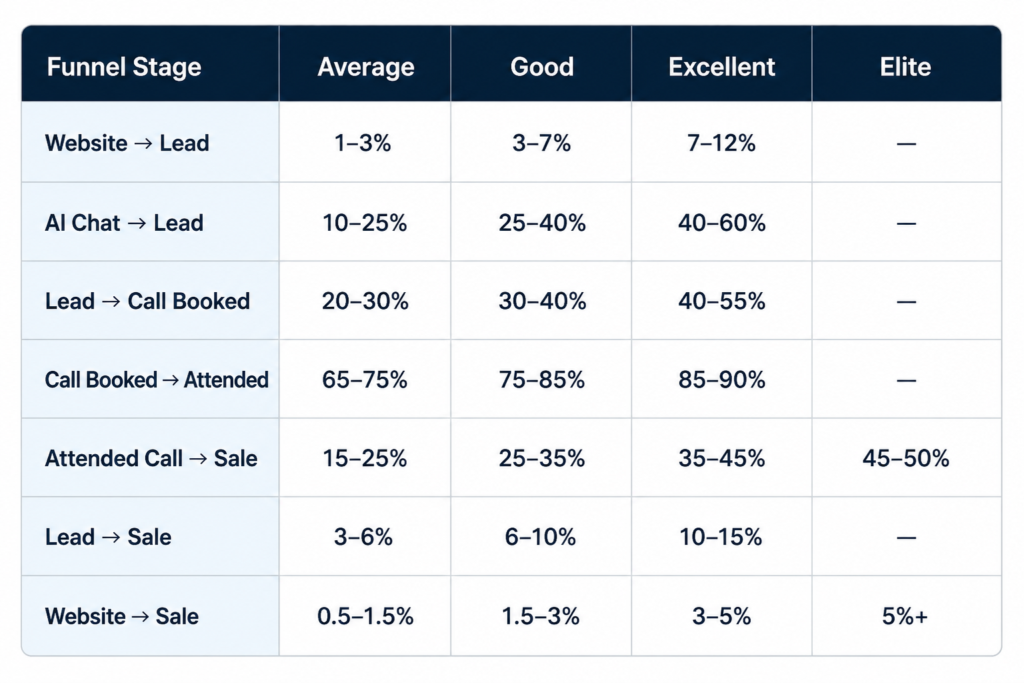
These numbers tell you something important: you don’t need to fix everything. You need to find the one or two stages where you’re leaking the most, and focus there.
For example, if your call booking rate is strong but your attendance rate is 52% (well below the 65–75% average benchmark), that’s your bottleneck. No amount of top-of-funnel optimisation will compensate for half your booked calls not showing up.
Where AI Fits: Stage by Stage
Let’s map AI solutions to each funnel stage. This isn’t theoretical — these are tools and approaches being used right now by sales teams across industries.
Stage 1: Website → Engagement → Lead
The problem: Most website visitors leave without engaging. Traditional forms convert at 1–3%. That’s a lot of wasted traffic.
The AI solution: Conversational AI chatbots engage visitors in real time, answer questions, and qualify interest before asking for details. This is why AI Chat → Lead conversion rates can hit 25–40% — dramatically outperforming static forms.
What this looks like in practice:
- A visitor lands on your training page at 9pm
- An AI chatbot greets them, asks about their career goals and timeline
- It qualifies their motivation, funding readiness, and programme fit
- It routes high-intent leads directly to an advisor’s calendar
- It nurtures lower-intent leads into a follow-up sequence
No human involvement needed until the lead is qualified and ready.
Stage 2: Lead → Call Booked
The problem: Leads go cold fast. Outreach’s 2025 sales data report found that lead qualification is the number one seller challenge in 2025, with reps struggling most at the top of the funnel.
The AI solution: Speed-to-lead automation. AI-powered workflows can trigger instant WhatsApp messages, SMS confirmations, and personalised email sequences within minutes of a lead arriving. Tools like Twilio WhatsApp, Wati, or GoHighLevel handle this without adding headcount.
The benchmark target? Respond within 5 minutes. After 30 minutes, your odds of converting that lead drop dramatically.
Stage 3: Call Booked → Call Attended
The problem: This is often the single biggest leak in a sales funnel — and it’s the most overlooked. Getting someone to book a call is hard. Getting them to actually show up shouldn’t be harder, but it often is.
The AI solution: Multi-touch reminder sequences across channels:
- Automated calendar confirmations
- SMS reminders 24 hours and 1 hour before the call
- WhatsApp voice notes from the advisor (personal touch, automated delivery)
- Pre-call commitment questions (“What’s the one thing you most want to discuss?”)
WhatsApp alone can drive response rates of 40–70% — far higher than email’s 3–7%. That’s not a marginal improvement. That’s a different game.
Stage 4: Attended Call → Sale
The problem: This stage is the most human-dependent — and that’s a good thing. But even great advisors benefit from better preparation and feedback.
The AI solution: Sales call intelligence tools like Gong, Chorus, or Fireflies can:
- Analyse talk-to-listen ratios
- Identify winning patterns across your best calls
- Generate AI summaries and next steps automatically
- Support structured coaching frameworks for team development
Outreach’s research found that using AI conversation intelligence (like their Kaia tool) shaves 11 days off sales cycles and boosts win rates by up to 10 percentage points on deals over £50K.
Take the steps to optimise the sales funnel with AI
Here’s where I want to challenge your thinking.
The tools I’ve listed above are powerful. But tools don’t implement themselves. And this is where most AI sales transformations go wrong.
As Walnut’s guide notes, 80% of sales leaders now consider AI integration critical for competitive advantage. But knowing AI matters and actually making it work in your organisation are two very different things.
To implement AI across your sales funnel effectively, you need three specific capabilities — and they’re the same ones that make great AI consultants so valuable:
1. Business Analysis — Understanding the Problem Before Buying the Solution
Before you touch any AI tool, you need to map your current funnel, identify your actual conversion rates, and pinpoint where the biggest gaps are. That’s business analysis.
Without it, you’ll end up buying a shiny AI chatbot when your real problem is call attendance. Or investing in sales intelligence software when your team doesn’t have a structured call framework to improve against.
The BA question: Where are we losing the most potential revenue, and why?
2. Agile Project Management — Prioritising and Iterating
You can’t fix everything at once. Agile thinking helps you prioritise the highest-impact change, implement it in a short cycle, measure the result, and iterate.
For a sales funnel, this might look like:
- Sprint 1: Implement WhatsApp reminders to improve call attendance from 52% to 75%
- Sprint 2: Deploy AI chat qualification to improve website-to-lead from 1.6% to 5%+
- Sprint 3: Build automated alumni nurture to increase repeat client rate from 7.7% to 15%
Each sprint has a clear goal, a measurable KPI, and a defined timeline. No boiling the ocean.
3. Change Management — Getting People to Actually Use It
This is the one that kills most AI projects. You can build the most elegant automation in the world, but if your sales team doesn’t trust it, doesn’t understand it, or feels threatened by it, it won’t get adopted.
Change management in a sales AI context means:
- Involving advisors in the design process
- Being transparent about what AI will and won’t replace
- Training the team on new workflows before going live
- Celebrating early wins to build momentum
- Monitoring adoption and adjusting based on feedback
Learn how to optimise your sales funnel using AI
The Bottom Line
AI is transforming the sales funnel. That’s not hype — the data backs it up. But the transformation isn’t really about the AI. It’s about having the skills to:
- Analyse your funnel and identify the real bottleneck (not the obvious one)
- Prioritise the right intervention and deliver it in focused sprints
- Manage the change so your team embraces new ways of working rather than resisting them
These are consultancy skills. And they’re exactly the skills that separate people who use tools from people who transform businesses.
Ready to Build These Consultancy Skills?
If this article has got you thinking about how you’d apply business analysis, agile project management, and change management to your own sales process then our Consultancy Skills Bootcamp is designed for exactly that.
It’s a practical, structured programme that teaches you the Consultancy Hat-Trick: Business Analysis, Agile Project Management, and Change Management. Whether you’re looking to step into consulting, a sales leader wanting to drive AI adoption more effectively, or a career changer building your toolkit — this bootcamp gives you frameworks you can use immediately.
Alongside these skills we will walk through the sales process step by step and help you to explore the possibilities with AI.
👉 Find out more and register for the Consultancy Skills Bootcamp in June — and learn how to turn great technology into real business results. Sign up now and get 20% off using the code ‘Bootcamp20’ before the 23rd May.
Recent Posts



Subscribe To Our Weekly Top Tip Bulletin
Get Updates And Learn From The Best