How to Find Your Next Salesforce Job or Project: Part 1 — Raise Your Profile

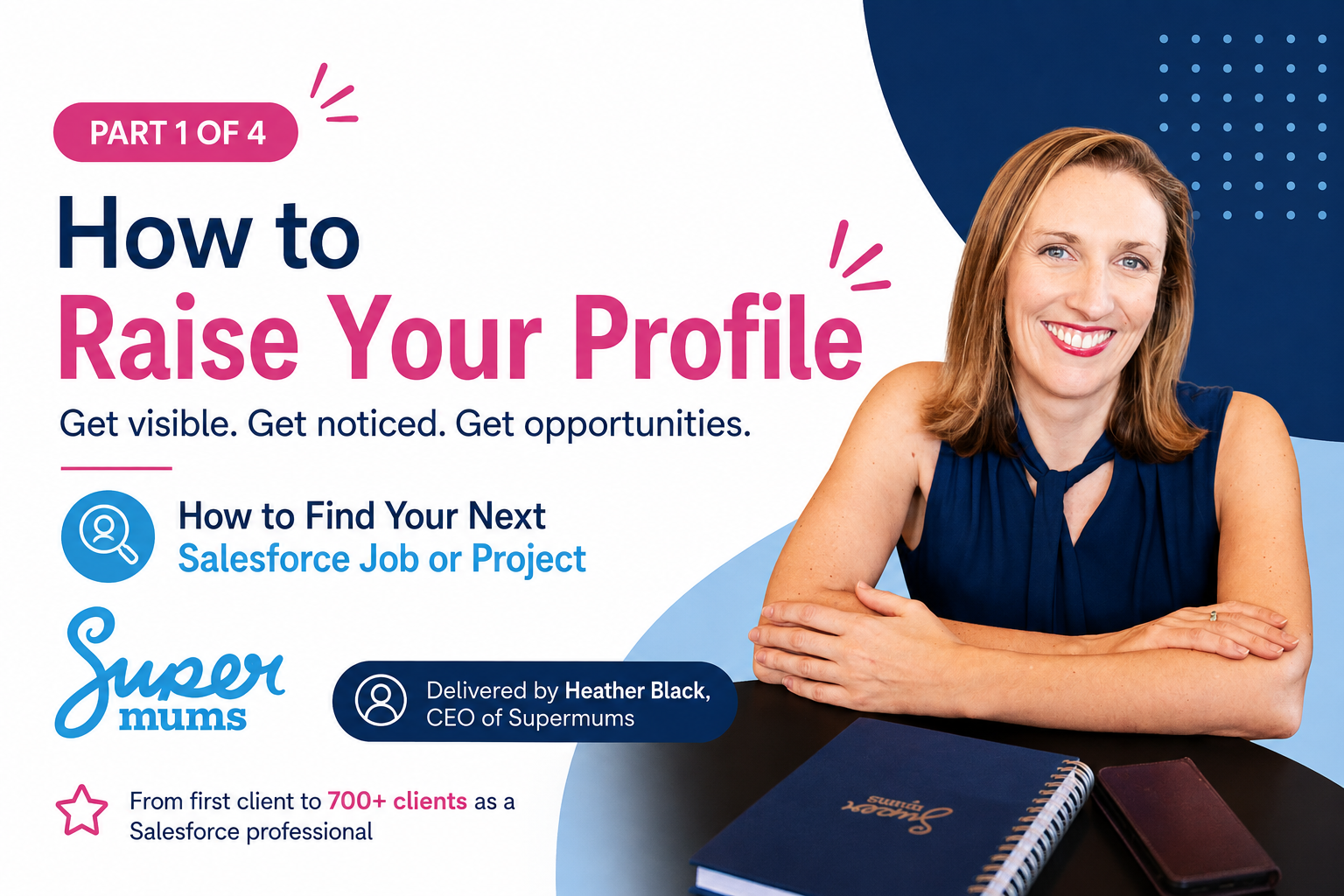
In this blog series we focus on helping you to find your next Salesforce job or project.
Finding your next Salesforce job or project is rarely just about having the right certification.
Your technical skills matter, but securing consistent work also depends on whether people know who you are, understand the value you offer and trust you enough to hire or recommend you.
I learned this first-hand when I began my own Salesforce journey.
I started by learning Salesforce, building my confidence and looking for opportunities to apply my skills. From there, I launched my freelance career, found my first clients and gradually built a Salesforce consultancy and recruitment firm that has now worked with more than 700 businesses.
That growth did not happen overnight. It came from following a repeatable approach to raising my profile, building relationships, demonstrating credibility and clearly communicating how I could help.

The Four-Part Formula for Finding Salesforce Work
Over four weeks, I am sharing the formula I have followed to secure new Salesforce work:
- How to Raise Your Profile
- How to Build Your Network
- How to Build Your Reputation
- How to Sell Yourself
This first article focuses on one of the most important foundations: raising your profile by creating useful content.
Raise your profile to find your next Salesforce job
You may be capable of doing the work, but people cannot hire someone they do not know exists.
Raising your profile on LinkedIn is not about becoming an influencer or posting online every day. It is about helping the right people understand:
- What you know
- What interests you
- What problems you can solve
- How you approach your work
- What experience you bring
- What makes you different
The aim is to become visible and memorable for the right reasons.
When a suitable Salesforce role or project becomes available, you want someone to think:
“I know exactly who could help with this.”
Content can help you achieve that. When someone comes to you, it’s best way to find your next Salesforce job.
Start before you need your next opportunity
The best time to raise your profile is before you urgently need another job or project.
Building visibility takes time. One post is unlikely to transform your career, but consistently sharing useful ideas can build recognition, trust and opportunity. Aim for four posts a week.
Start with what you already know.
Choose one subject. Share one lesson. Explain one approach. Tell one useful story.
You do not need to know everything. You simply need to offer something that helps the person reading it.
At Supermums we run a LinkedIn Challenge for our community, and we encourage our learners to think about the following topics to write content about:
Define your Salesforce niche to find your next Salesforce job
Before you start writing, think carefully about what you want to become known for.
Your niche does not have to be based only on your current Salesforce experience. You can define it using your previous career expertise, your industry knowledge or an area of Salesforce you want to develop in the future.
For example, your niche could be:
- Non Profit Cloud
- Health Cloud
- Service Cloud
- Salesforce integrations
- Change management and adoption
- Marketing automation
- and more..
You can also bring together your previous career and your developing Salesforce skills.
Someone with a background in healthcare may decide to focus on Health Cloud. Someone who has worked in operations may create content about process improvement and automation. Someone with a marketing background may focus on lead generation, customer journeys or Account Engagement.
Your previous experience is not irrelevant. In many cases, it is what makes you more valuable.
Use your previous expertise: Share your Blueprint
I recently worked with three Salesforce professionals, helping them to wrote their CVs. Each person had valuable industry experience, but they had not yet recognised how this experience could shape their professional profile.
One had led operational and technology transformation within the consumer goods industry.
Another had implemented customer acquisition and customer success strategies for different health and wellbeing brands.
The third had worked in event management for several years while using Salesforce.
Each person had a different story, perspective and area of credibility. They did not need to write generic posts about Salesforce features. They could create content based on what they already understood deeply.
For example:
- The transformation leader could write about approaching operational change, stakeholder management and technology adoption in the Consumer Goods sector.
- The health and wellbeing specialist could share ideas around customer acquisition, retention and successful customer journeys in membership based organisations like Gyms.
- The events professional could discuss how Salesforce can support event management, delegate engagement, sponsorship and follow-up from her direct experience.
The strongest content often sits at the intersection of your existing expertise and your growing Salesforce knowledge. Sharing your professional expertise and boosting your credibility will help you find your next job.
Share what you are learning
You do not need to position yourself as the world’s leading expert before you start writing.
Sharing what you are learning can be one of the easiest and most authentic ways to raise your profile.
You could write about:
- What you learned by attending a Salesforce event
- What you learned during your most recent project
- What you learned from a training course
- A feature you recently tested
- A mistake you made and how you solved it
- A new Salesforce release that interests you
- A business problem you now understand differently
- A practical exercise that helped build your skills
Do not simply write, “I attended an event and it was great.”
Explain what changed in your thinking.
For example:
I attended a Salesforce event this week and one of my biggest takeaways was the importance of involving users earlier in a transformation project. It made me reconsider how I would approach requirements gathering and user testing on my next implementation.
That is more useful, more personal and more memorable. Make sure to tag the trainers or speakers.
Don’t be afraid to mention that you are looking to find your next Salesforce job on a post.
Share useful Salesforce benchmarks and best practice
Useful content gets saved, shared and remembered.
Think about the information your target audience would find valuable. This could include:
- Adoption benchmarks
- Service desk measures
- Data quality checks
- User testing best practice
- Project planning templates
- Discovery questions
- Stakeholder engagement tips
- Common Salesforce implementation stages
- Questions to ask before choosing a new solution
- Ways to measure return on investment
You do not need to produce a detailed white paper every week. A practical checklist, simple graphic or short post can be enough.
The question to ask is:
“Would this help someone make a better decision or do their job more effectively?”
Share Salesforce success stories
Success stories help demonstrate that you can turn knowledge into results.
You can share stories from your work, volunteering, training, work experience or personal projects. Always protect confidential information and obtain permission where appropriate.
A useful structure is:
- What was the original challenge?
- What was your role?
- What approach did you take?
- What changed as a result?
- What did you learn?
Even small successes are worth sharing.
Perhaps you improved a process, supported a user, helped organise requirements, created a useful report or identified a data issue before it became a larger problem.
These stories provide evidence of how you work and will attract people to you. Building trust is important to find your next Salesforce job.
Share the risks to avoid: Lesson’s learn’t
Some of the most valuable content explains what can go wrong and how to mind the gap.
You could write about things you have seen on projects..
- Why projects fail to secure user adoption
- Common mistakes during requirements gathering
- Risks caused by poor data quality
- Why unclear ownership creates problems
- The danger of building before understanding the business need
- What happens when users are not involved early enough
- Why over-customisation can create long-term challenges
Talking about risks shows maturity and practical awareness.
It demonstrates that you are not simply interested in building technology. You understand the wider consequences of project decisions.
The content will help you prepare for interviews
Creating all of this great content helps you to consolidate your thoughts and strategy.
The content builds your talk track that is valuable to share at an interview.
Writing content helps you to build your confidence and your credibility.
Getting engagement on your content boosts your self-esteem and builds your network.
Getting feedback from your content starts to build your reputation.
What’s to do next to find your next Salesforce job
Next week, I will explore the second part of the formula: how to build your network and create genuine professional relationships that lead to opportunities.
Join the Supermums Boost your Salesforce Career Bulletin to receive the full four-part series, practical Salesforce career advice and details of new Salesforce job and project opportunities.


Recent Posts








Subscribe To Our Weekly Top Tip Bulletin
Get Updates And Learn From The Best