Four Ways to Motivate People to Change

Change is rarely resisted because people are simply being difficult. More often, people resist because they feel uncertain, unheard, unconvinced or worried about what the change will mean for them. In this blog we summarise the four ways to motivate people to change.
Successful change management cannot rely on training alone.
You can explain a new system, demonstrate a new process and provide detailed instructions, but people may still fail to adopt it. The real challenge is often not a lack of knowledge. It is a lack of motivation, confidence, trust or emotional readiness.
Different people respond to change in different ways. Some are motivated by recognition and clear expectations. Others need to understand the benefits, talk through their concerns or feel a greater sense of choice and ownership.
A strong motivational strategy recognises these differences and uses the right approach for each audience.
Four ways to motivate people to change
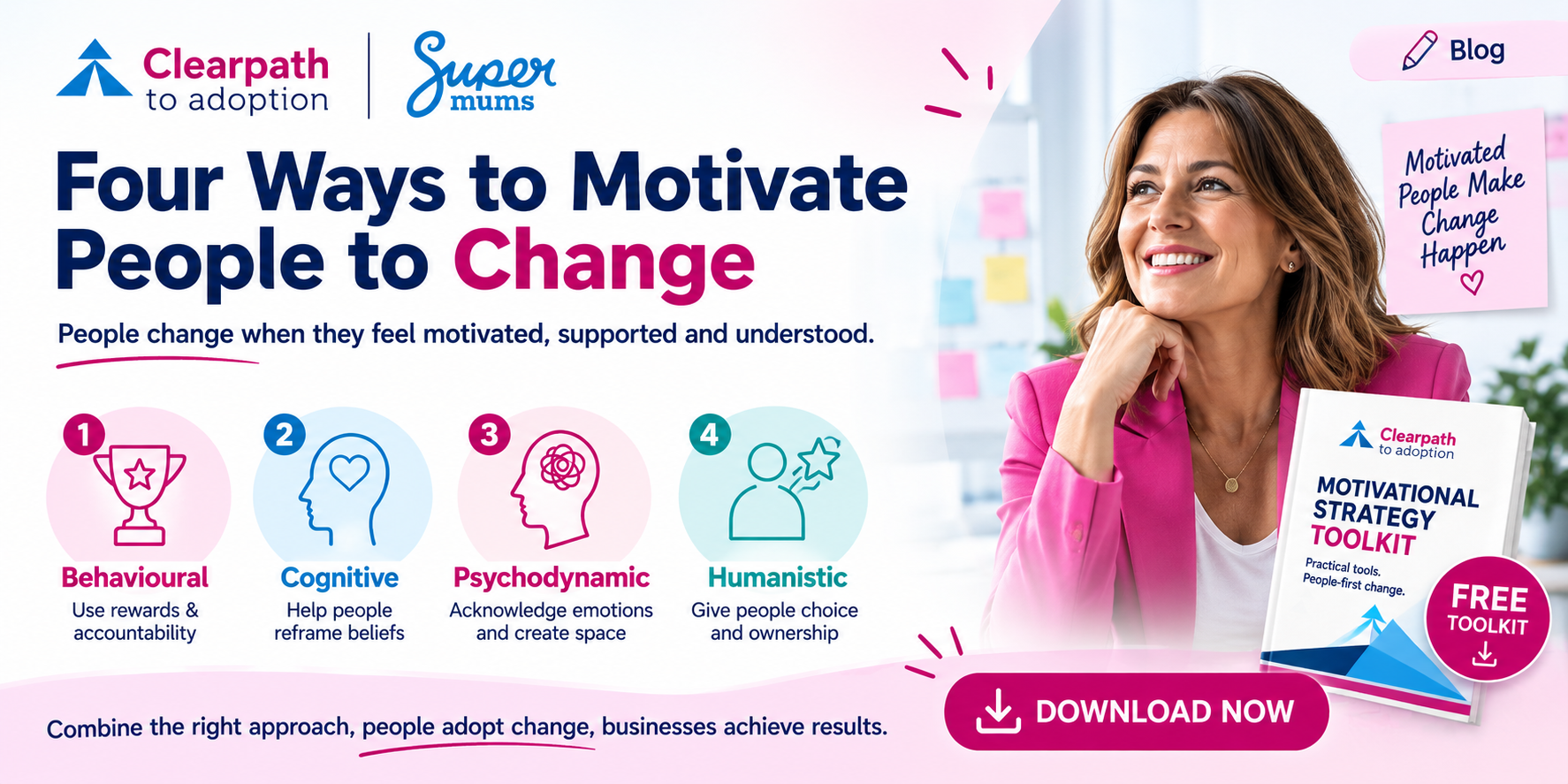
There are four main ways to motivate people to change: behavioural, cognitive, psychodynamic and humanistic. Each focuses on a different aspect of human motivation. Used together, they can help organisations reduce resistance, build engagement and achieve lasting adoption.
1. Behavioural motivation: rewards and accountability
The behavioural approach focuses on external drivers.
People are encouraged to adopt a new behaviour because there is a reward for doing so or a consequence for failing to meet expectations. This approach can be particularly effective in performance-led organisations where targets, recognition and accountability already form part of the culture.
Examples include:
- Recognition for employees who adopt the new process
- Gamification, such as points, badges or leaderboards
- Financial bonuses or incentives
- Career progression opportunities
- Skills development
- Clear performance expectations
- Action learning
- Compliance requirements
For example, an organisation introducing a new CRM system might recognise the teams that maintain the best data quality or achieve the highest level of platform usage. Managers could include adoption measures in team objectives and provide additional support where expectations are not being met.
The behavioural approach is useful because it creates clarity. People know what is expected, how success will be measured and what the outcome of their actions will be.
However, rewards and consequences should be used carefully. If people are only motivated by incentives, their behaviour may stop when the reward disappears. Accountability without adequate support can also create fear or resentment.
The strongest behavioural strategies combine clear expectations with positive reinforcement. Recognition should feel meaningful, and performance management should be fair, transparent and supported by appropriate training.
2. Cognitive motivation: positive reframing
The cognitive approach focuses on how people think about change.
Employees often develop beliefs such as:
“This new system will make my job harder.”
“I am not confident with technology.”
“The old process worked perfectly well.”
“This change will not benefit me.”
These beliefs shape emotional reactions and influence behaviour. If people believe the change is unnecessary, threatening or too difficult, they are unlikely to engage fully.
This is why organisations cannot always “train away” resistance. A belief problem needs to be addressed before a knowledge problem can be solved.
Cognitive interventions can include:
- Clear goal setting
- Measures of success
- Visioning exercises
- Positive reframing
- Action planning
- Coaching
- Confidence building
- Demonstrating personal and business benefits
Positive reframing means helping people see the change from a different perspective.
Instead of presenting a new platform as another administrative burden, explain how it could reduce repetitive work, improve visibility or make it easier for employees to achieve their goals. Show people how the change connects to their daily frustrations and priorities.
It is also important to make success feel achievable. Large transformation programmes can feel overwhelming, so break the change into smaller actions and milestones. Give people opportunities to build confidence, practise new skills and see evidence of progress.
The cognitive approach works best when communication is specific and credible. Employees will quickly reject messaging that feels unrealistic or overly positive. Acknowledge the challenges honestly while helping people understand why the change matters and what support is available.
3. Psychodynamic motivation: emotional engagement
The psychodynamic approach focuses on the emotions that sit beneath visible resistance.
People may appear negative, disengaged or uncooperative, but their behaviour could be driven by deeper concerns. They may be worried about job security, fear losing their expertise or feel that previous changes were badly managed.
Some concerns may not be expressed openly.
During significant change, people can move through emotional responses such as denial, anger, bargaining, low mood and eventual acceptance. Not everyone experiences change in the same way or at the same pace.
Useful interventions include:
- Honest conversations
- Facilitated discussions
- Counselling or wellbeing support
- Listening sessions
- Addressing fears about job security
- Surfacing hidden concerns
- Creating safe opportunities for feedback
- Acknowledging emotional responses
The biggest mistake organisations make is dismissing emotional reactions as negativity.
Telling people to “be more positive” does not address the real issue. It can make them feel ignored and increase resistance.
Leaders and change teams need to create space for employees to express concerns without fear of judgement. This does not mean every objection should stop the project. It means concerns should be heard, understood and responded to respectfully.
Psychodynamic motivation is especially important when change affects people’s identity, status, responsibilities or sense of security. A new system may appear technical, but it can still make someone feel that their knowledge is becoming less valuable.
By surfacing these concerns early, organisations can address the real barriers to adoption rather than repeatedly treating the visible symptoms.
4. Humanistic motivation: development and growth
The humanistic approach focuses on personal growth, choice and ownership.
People are more likely to engage with change when they feel respected, involved and able to influence their own experience. They want to understand what the change means for them and how it could support their future development.
Humanistic interventions can include:
- Two-way communication
- Consultation and employee involvement
- Learning and development
- Personalised support
- Training and certification opportunities
- Career development
- Giving people meaningful choices
- Encouraging self-responsibility
- Connecting the change to personal aspirations
For example, instead of simply requiring employees to complete system training, organisations could offer different learning routes based on confidence and experience. Employees might choose between live workshops, guided practice, online learning or peer support.
The organisation could also show how the new skills support career development.
When people feel that change is being done to them, resistance tends to increase. When they feel involved in shaping the change, they are more likely to take ownership.
However, consultation needs to be genuine. Asking for feedback and then ignoring it can damage trust. Organisations should be clear about what employees can influence, what has already been decided and how feedback will be used.
Choosing the right approach to motivate people to change
There is no single strategy that works for everyone.
Before deciding how to motivate people, assess the organisation’s culture and current environment. Is the culture driven by performance and accountability, or by collaboration and personal growth?
Next, map the emotional states of different stakeholder groups. Some may be excited, while others are anxious, sceptical or disengaged.
The final strategy should balance organisational objectives with individual needs. One team may respond well to recognition and measurable targets, while another may need greater reassurance, involvement and emotional support.
The most effective change programmes use all four approaches to motivate people to change.
Rewards can encourage action. Positive reframing can build belief. Emotional engagement can reduce hidden resistance. Development and ownership can create lasting commitment.
Change becomes sustainable when people understand what is expected, believe the change is worthwhile, feel heard and see a meaningful role for themselves within it.
Introducing Clearpath and a Toolkit to motivate people to change
Download the free toolkit to learn different ways to motivate people to change.
Motivating people through change requires more than good communication. It requires a structured approach that considers behaviour, beliefs, emotions and personal aspirations.
Download the free Clearpath to Adoption Toolkit for practical tools and templates to help you engage people, reduce resistance and drive lasting adoption:

Recent Posts








Subscribe To Our Weekly Top Tip Bulletin
Get Updates And Learn From The Best