Salesforce Headless 360: What Admins need to learn next

Salesforce just announced Headless 360 so what does this mean for your career? The traditional Salesforce Admin role is changing. Here’s what you need to learn beyond admin skills and how to position yourself for the roles that will pay the most in 2026 and beyond.
The Highlights of Salesforce Headless 360
- Salesforce Headless 360 means Salesforce is no longer just a browser-based tool. It’s becoming a data and automation engine that powers AI agents, Slack, WhatsApp, voice, APIs, and external interfaces. Every Admin needs to understand what this shift means for their skills.
- The Admins who thrive will be the ones who go beyond clicks and configuration to learn AI agent management, integrations, advanced automation, and data governance.
- Supermums has mapped out four clear career tracks that align to this new reality, from getting your first Admin role through to leading as an AI Admin, Consultant, or Product Specialist.
Introduction to Salesforce Headless 360
Salesforce just dropped something big. It’s called Salesforce Headless 360, and the short version is this: Salesforce will no longer become a platform you log into. It’s becoming an operating system that powers everything behind the scenes.
That might sound abstract, so let me make it concrete. Salesforce has announced that everything on its platform is now an API, an MCP tool, or a CLI command. Translation: the data, the automation, the intelligence inside Salesforce can now be accessed and used by AI agents, Slack bots, voice assistants, WhatsApp channels, and external apps, without anyone ever opening a Salesforce tab.
If you’re a Salesforce Admin reading this thinking “OK, but what does that mean for me?”, the answer is: quite a lot. And most of it is good news, if you act now.
The Admin role isn’t disappearing. But it is changing shape. Fast. The professionals who will earn the most and have the most options over the next two to three years are the ones who start building new skills today.
I’m going to walk you through what’s changing, which skills matter most, what career tracks are opening up, and how Supermums can help you get there.
What Salesforce Headless 360 actually means
Traditionally, Salesforce has lived inside the browser. You log into it, navigate Lightning pages, run reports, manage records. The UI was the product.
Headless 360 breaks that model. The “head” (the user interface) is being separated from the “body” (the data, logic, automation, and intelligence). Salesforce becomes the engine room, and the user experience can happen anywhere: inside Slack, through a chatbot, via an AI agent on your website, over WhatsApp, through a voice assistant, or in a completely custom app.
For businesses, this is powerful. It means they can use Salesforce data and automation across every channel without forcing employees or customers into the Salesforce UI.
For Salesforce Admins, it means the job description is expanding. You’re no longer just managing page layouts and permission sets inside Lightning. You’re increasingly responsible for how Salesforce data and processes work across multiple touchpoints, many of which don’t have a traditional screen at all.
What skills do Salesforce Admins need now
Let me be direct: classic Admin skills still matter. You still need to understand objects, fields, security models, reports, and Flow. Nobody is saying throw that knowledge away.
But if classic Admin is all you know, you’re going to find it harder to stand out. The market is moving, and the premium is shifting towards Admins who can do more.
Here are the six skill areas that matter most right now, ranked by what will accelerate your salary and career fastest in the UK market.
1. AI and Agentforce administration
This is the highest priority skill area, full stop.
Salesforce Agentforce is here, and organisations are starting to deploy AI agents that handle customer queries, process requests, and support internal teams. Someone needs to set up, manage, and govern those agents. That someone is the Admin.
What you need to learn:
- Agentforce setup and configuration
- Prompt design (telling AI agents what to do and how to behave)
- Agent permissions and access boundaries
- Escalation rules to human agents
- Testing for hallucinations and errors
- Conversation analytics
- Governance and audit trails
The job titles emerging around this are things like AI Admin, Agentforce Admin, and AI Operations Admin. There are very few people with these skills right now, which means there’s a genuine salary premium for those who get there early.
2. API and integration skills
This is one of the biggest hidden salary multipliers for Admins, and most people avoid it because it sounds too technical.
Here’s the reality: if users are interacting with Salesforce through Slack, WhatsApp, and AI agents rather than logging into the UI, something still needs to move the data around. That’s integrations. Admins who understand how data flows between systems become far more valuable than those who only know how to configure what’s inside Salesforce.
You don’t need to become a developer. But you do need to understand:
- REST APIs at a basic level
- Webhooks
- Named Credentials
- External Services in Salesforce
- Middleware concepts (how tools like MuleSoft connect things)
- How to troubleshoot data sync issues
Most Admins treat integrations as “someone else’s problem.” If you lean into this, you immediately stand out.
3. Advanced Flow and process automation
Admins who can automate complex business processes are always in demand, and that demand is only growing. As organisations try to do more with less, the ability to design robust, scalable automation is a career accelerator.
Go deeper than basic record-triggered Flows. Learn:
- Complex Flow design with error handling
- Modular automation using reusable subflows
- Trigger strategy (when to fire what, and in what order)
- Approval orchestration
- Process documentation
The mindset shift here is from “builder” to business systems architect. You’re not just wiring things together; you’re designing how the business operates. Get started with Platform App Builder
4. Business analysis and stakeholder skills
This is where many technical Admins get stuck. You might be brilliant at configuration but struggle to undertake business analysis, gather requirements, run workshops, or present a solution to a senior stakeholder.
Technical people who can translate business needs earn more. It’s that simple. If you want to move from Admin to Senior Admin, Systems Analyst, or Consultant, you need:
- Requirements gathering techniques
- Workshop facilitation
- Executive reporting and communication
- Solution design skills
- The confidence to push back on bad requirements
This is the bridge between “I do what I’m told” and “I advise the business on what to do.”
5. Security and governance
As AI agents gain access to Salesforce data and take actions on behalf of users, security becomes higher stakes. A misconfigured permission set on a human user is a problem. A misconfigured permission on an AI agent that processes thousands of transactions a day is a crisis.
Learn:
- Least privilege design principles
- Permission set architecture
- Field-level security
- Agent access scopes
- Audit logging and monitoring
- Compliance workflows
- AI governance policies
This is especially valuable if you work in financial services, healthcare, government, or any regulated sector.
6. Data Cloud
Salesforce Data Cloud is a powerful platform for unifying customer data, and it’s increasingly important for organisations using AI. Bad data means bad AI. Someone needs to own data quality, identity resolution, segmentation, and consent management.
This is a niche premium skill. Not every organisation uses Data Cloud yet, but where it’s deployed, the people who understand it are in high demand. Best suited for Admins moving into marketing ops, analytics, or enterprise environments.
Quick insight: what to spend less time on
You don’t need to abandon classic Admin skills, but don’t let them be the centrepiece of your learning plan. Spend less time perfecting page layouts, manual data entry processes, UI-only customisation, and basic reports. These are table stakes, not differentiators.
Salesforce career tracks for 2026 and beyond
Here’s where this gets practical. Based on what employers are hiring for and where salaries are heading, there are four clear career tracks for Salesforce professionals in 2026.
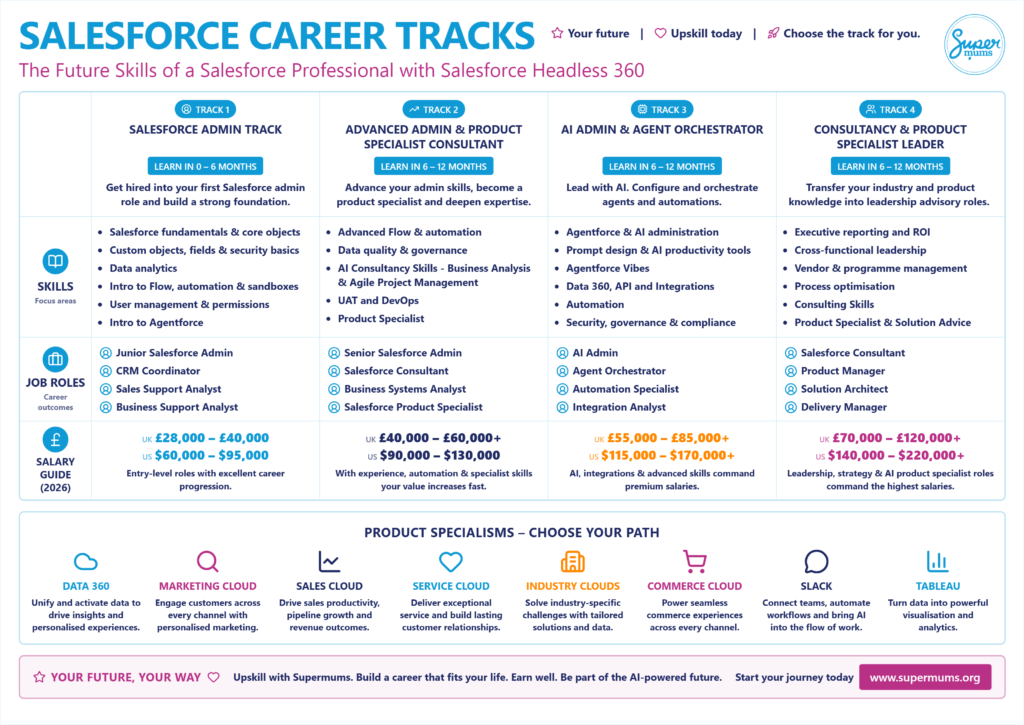
Track 1: Salesforce Admin (Foundation)
Learn in 0 to 6 months. This is your entry point. Salesforce fundamentals,.
Focus on learning: Salesforce administration basics – custom objects, security basics, data analytics, intro to Flow, user management, and an introduction to Agentforce.
Target roles include Junior Salesforce Admin, CRM Coordinator, Sales Support Analyst, and Business Support Analyst.
UK salary range: £28,000 to £40,000 / USA salary range: $60,000 to $95,000
Track 2: Advanced Admin and Product Specialist Consultant
Learn in 6 to 12 months. Advance your admin skills and become a product specialist.
Build on your foundation with advanced Flow and automation, data quality and governance, AI consultancy skills (business analysis and agile project management), UAT and DevOps, and product specialisation.
Target roles include Senior Salesforce Admin, RevOps Analyst, Business Systems Analyst, and Salesforce Product Specialist with a focus on Data 360, Marketing Cloud, Sales Cloud, Service Cloud, Industry Clouds, Commerce Cloud, Slack, or Tableau.
UK salary range: £40,000 to £60,000+. / USA salary range $90,000 to $130,000
Track 3: AI Admin and Agent Orchestrator
Learn in 6 to 12 months. This is the premium skills track.
Focus on learning: Agentforce and AI administration, prompt design and AI productivity tools, Data 360, APIs and integrations, advanced automation, and security, governance, and compliance.
Target roles include AI Admin, Agent Orchestrator, Automation Specialist, and Integration Analyst.
UK salary range: £55,000 to £85,000+. / USA Salary Range $115,000 – $170,000
Track 4: Consultancy and Product Specialist Leader
Learn in 6 to 12 months. Transfer your industry and product knowledge into leadership advisory roles.
Focus on learning: Executive reporting and ROI, cross-functional leadership, vendor and programme management, process optimisation, consulting skills, and product specialist solution advice.
Choose a product specialism: Agentforce, Data 360, Marketing Cloud, Sales Cloud, Service Cloud, Industry Clouds, Commerce Cloud, Slack, or Tableau.
Target roles include Salesforce Consultant, Product Manager, Solution Architect, and Delivery Manager.
UK salary range: £70,000 to £120,000+. / USA – $140,000 – $220,000
How Supermums helps you get there
Supermums has been training Salesforce professionals for years, Our training programmes are structured around real-world skills that employers actually hire for, not just certification prep.
Find out more below and book a call with our team now to discuss which course is right for you.
- Consultancy Skills : Get your Business Analysis Cert – On-Demand / Bootcamp: Starts June
- Salesforce Admin – Get your Salesforce Admin Cert – Next start date: May
- Spanish Salesforce Admin – Get your Salesforce Admin Cert – Next start date: May
- Data 360 – Get your Data Cloud Consultant Cert – Next start date: May
- Marketing Cloud – Get your Email Specialist Cert – Next start date: May
- Agentforce Bootcamp – Next start date: June
- Platform App Builder – On Demand
- Service Cloud Consultant Course – On Demand
- AI Tools for Salesforce Projects – On Demand
Looking to train your employees? Talk to us about in-house training today email lyn@supermums.org
Here’s what makes Supermums different:
Practical skills, not just theory. We teach you to do the work, not just pass an exam. That means real scenarios, stakeholder conversations, and hands-on projects. Our Consultancy Skills training covers business analysis, agile project management, and change management because those are the skills that get you promoted.
Career enablement built in. Every programme includes access to careerr advice from CV rewriting, LinkedIn optimisation, interview practice, and confidence building. We know that many talented professionals, especially women and career changers, hold themselves back because they don’t know how to articulate their value. We fix that.
AI and future skills are already in our curriculum. We’re not playing catch-up. Our training already covers Agentforce, AI productivity tools, integration fundamentals, and governance. We’re training next-generation Salesforce AI Administrators, right now.
Community and support. You don’t do this alone. Supermums learners get coaching, mentoring, and access to a community of people on the same journey. That matters more than most people realise when you’re making a big career change.
Flexible learning that fits your life. Our programmes are designed for people who have lives outside of work and study. Many of our learners are parents, returners, or career changers who need structure but also flexibility.
If you’ve been looking at the Salesforce ecosystem and wondering where you fit in this new world of AI agents, headless architecture, and API-first thinking, the answer is: right in the middle of it. The demand is there. The salaries are real. You just need the right skills and the right support to get there.
We look forward to seeing you flourish in this career!
Frequently asked questions about Salesforce Headless 360
What is Salesforce Headless 360? Salesforce Headless 360 is Salesforce’s new architecture that separates the user interface from the platform’s data, automation, and intelligence. It means Salesforce can power AI agents, Slack bots, WhatsApp channels, and external apps without users ever logging into the Salesforce UI.
Is the Salesforce Admin role going away? No. But it is evolving. Admins who only know classic UI configuration will find it harder to stand out. Admins who add skills in AI agent management, integrations, advanced automation, and data governance will be in high demand.
What is an Agentforce Admin? An Agentforce Admin is a Salesforce professional who manages AI agents built on Salesforce’s Agentforce platform. They handle agent setup, prompt design, permissions, escalation rules, testing, and governance.
How much do Salesforce Admins earn in the UK in 2026? Entry-level Admins typically earn £28,000 to £40,000. Mid-level Admins with advanced skills earn £40,000 to £60,000+. AI Admins and specialists with integration and automation skills can command £55,000 to £85,000+. Consultants and leaders can reach £70,000 to £120,000+.
How do I become a Salesforce AI Admin? Start with a solid foundation in core Salesforce Admin skills, then build expertise in Agentforce setup, prompt design, AI governance, API fundamentals, and advanced automation. Supermums offers structured training programmes that cover this full pathway.
Recent Posts





Subscribe To Our Weekly Top Tip Bulletin
Get Updates And Learn From The Best